objgraph got
- shiny documentation built with Sphinx.
- Python 3.x support, thanks to Stefano Rivera.
- Python 2.4 and 2.5 support, thanks to Daniel Blackburn.
- assorted smaller improvements.
zodbbrowser got
- support for all ZODB databases, not just those with a Zope 3/Bluebream-style root folder/local site.
- the ability to cope better with broken objects (due to the way ZODB works, not having some of your modules on the Python pack can break unpickling; zodbbrowser now handles this kind of situation better).
- assorted smaller improvements.
- a slow but inevitable shift of focus from "use it as a plugin for your Zope 3 app" to "it's a standalone tool for inspecting ZODB contents". (Both use cases are still supported, and will be for the foreseeable future.)
imgdiff got
- its first public release.
- some experimental code to actually find and highlight the differing
parts of the images:
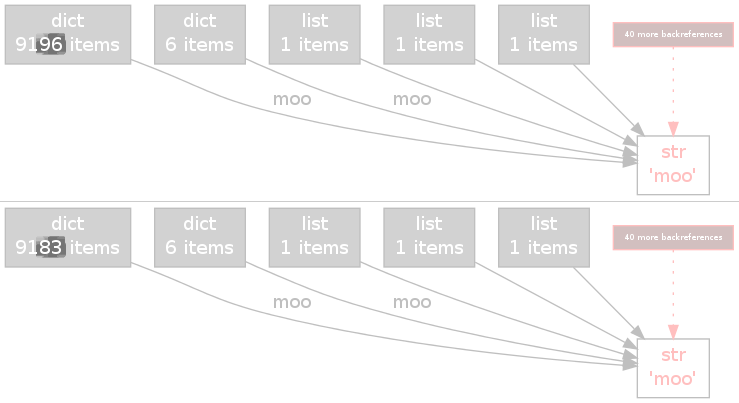
This works better when both images are the same size, although there's experimental (and somewhat buggy) code to try all possible alignments. I could use some help here; image processing is not something I'm familiar with, and searching StackOverflow didn't help beyond reminding me of the existence of PIL's ImageChops.difference(), which is for same-sized images only. Many of the results there are about comparing photos, where things like lighting levels matter. What I need is a diff for computer-generated images, where some things may be shifted around a bit, by different amounts, but are essentially the same. Are there any two-dimensional sequence diff algorithms?